
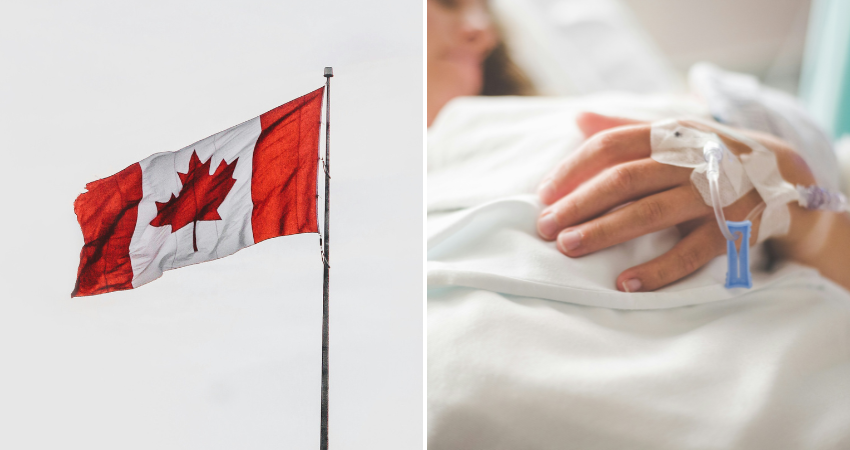
Canada hits new record as 1 in 20 deaths a result of Euthanasia
Image credit: Renan Kamikoga / Stephen Andrews via Unsplash
Canada has hit a new record of euthanasia deaths as official statistics found that 1 in 20 people who have died in Canada, were killed under the country's MAiD program.
According to official statistics from Canada, a total of 16,499 people died by euthanasia in Canada in 2024, a 6.9% increase from the previous year and a record high for the country. The statistics also show that 5.1% (1 in 20) of people who died in Canada were killed under Canada’s Medical Aid in Dying (MAiD) program. This makes the total number of deaths under MAiD coming to 76,475 since Canada made euthanasia and assisted suicide legal back in 2016.
Official statistics divided the figures into tracks, with Track 1 being those whose deaths were reasonably foreseeable”, and Track 2 being those whose deaths were not reasonably foreseeable”, which included those suffering with diabetes, frailty, autoimmune conditions and chronic pain. The number of deaths from those in Track 2 increased from 625 to 732 between 2023 and 2024.
As part of the application to request for euthanasia, medical practitioners reported that 75.5% of people reported “loss of independence” as a reason for their request, as opposed to 52.2% from the year before. Additionally, “perceived burden on family, friends or caregivers” was reported by 48.5% people overall, with 50.3% of people in Track 2 reporting this concern.
22.9% of people overall reported “isolation or loneliness” as a reason for seeking euthanasia, whereas a much higher percentage of those from Track 2 reported this as a reason, with 44.7% expressing this concern.
Additionally, 31.6% of people who died by euthanasia in Track 1 identified as someone with a disability, compared to 61.5% in Track 2 who reported this identity.
Several concerns have arisen from Canada’s MAiD program where reports of vulnerable people are being offered and even pressured into availing of the program, such as Roger Foley, who is fighting for his life after doctors repeatedly ask him if he wants MAiD after repeatedly requesting assisted living. Several other cases have come to light of people with disabilities being offered MAiD despite seeking help, such as Christine Gauither, an army veteran seeking a chair lift for her home, an elderly woman who sought a life saving surgery for breast cancer, and a disabled woman with depression seeking mental health support so she can live.
These concerns have prompted many people from the UK to refer to Canada’s MAiD program as a reason to not pass the assisted suicide bill that is currently being debated on. Those amongst the disabled community have been particularly vocal about the fears they have over such laws and the impact it could have on those suffering with disabilities, with TV star Liz Carr, who suffers with a disability herself, saying that those who are disabled are “frightened and threatened” by assisted suicide.
Canada are now in the process of expanding their law to allow for those who suffer with mental health problems to avail of assisted suicide.
Sandra Parda of the Life Institute commented, saying: “These statistics should be a very serious cause for concern, especially as so many of those whose deaths were not “reasonably foreseeable” identified as someone with a disability. What message does this send to the disabled community?”
“Instead of expanding their law, Canada needs to take a good look at how much their law is impacting and influencing attitudes towards the disabled community. It’s no wonder they are terrified of such laws.”
“It is deeply disturbing to see such an increase in deaths by euthanasia, especially as all these people are being sold the idea that death is the solution to suffering. We are all human beings who deserve to be treated with greater respect than this, not like worthless beings who can be cast aside.”
Featured
- Prof: Coppinger’s ‘non-binary’ law would damage data accuracy
- FF’s Martin Daly slammed for ‘attacks’ RE abortion hearing
- Court of Appeal considers case of pastor convicted for preaching the gospel
- Pastor in court TODAY to appeal conviction for preaching John 3:16 in abortion buffer zone
- ANOTHER teacher in UK suing for discrimination after being fired for pro-life views
- Christian woman pleads “not guilty” to NEW charges for silent prayer outside abortion facility
- Woman’s euthanasia request granted in Canada because she could no longer cook for her family
- Person from Victoria dies by suicide after taking assisted suicide drugs meant for their partner
- Pastor to appeal conviction for preaching John 3:16 in abortion buffer zone
- Pro-Life Victory in Belfast: City Hall Illuminated for Life
- “Deplorable”: Anger as Mansion House lit up for abortion
- Controversial abortion light-up at Belfast City Hall on hold
- Family claims 83-year-old was euthanised without giving consent
- Pro-life billboards VANDALISED in Co. Offaly
- TCD abortion “training day’ to include vacuum abortion procedure
- Cavan Choose Life: “eliminating 3-day wait is morally reckless”
- Teen hairdresser wins £30k after boss “tells her to abort baby”
- Thousands expected to gather in London for annual March for Life UK
- Belfast councillors vote to light up City Hall in support of abortion
- GP group admits it did not survey members on three-day wait
- Poll: 55% support keeping the 3-day wait before abortion
- Westminster: MPs vote against Assisted Suicide Bill
- Abortion clinics treated with more respect and protection than Mass in the UK
- Reckless government ignoring the warning signs of a broken system, all for the sake of abortion
- Belfast City Hall “shouldn’t be used as a billboard for abortion”
- Life Institute submission to Health Committee: scrapping three-day wait “a significant betrayal of voter trust”
- Rally for Life Vox Pops
- Have you heard Michael Jackson’s pro-life song, ‘Abortion Papers’?
- You are not entitled to a child.
- EXCLUSIVE — Esme’s open-letter: “The 3-day wait was my saving grace. Abolishing it would be catastrophic”
- Let down by her GP, rushed into an abortion with no three-day wait: the future our government wants?
- Over 900 women sought HSE counselling after abortion since 2023
- Rally for Life 2026
- We Remember them 2026

You can make a difference.
DONATE TODAY