
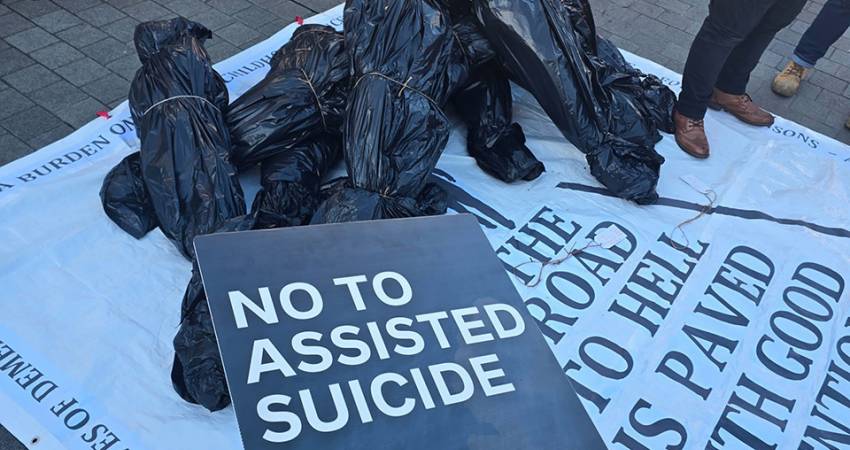
Britain: Assisted Suicide Bill ‘will almost certainly fail’
Britain’s assisted suicide Bill “will almost certainly fail” due to a lack of time, Sky News has reported. The Terminally Ill Adults (End of Life Bill) remains under scrutiny in the upper chamber after Members of the British Parliament (MPs) in the Commons voted in support of the legislation by 314 votes to 291 last year.
However, the controversial legislation to permit the practice in England and Wales looks to be on the verge of collapsing because of a shortage of parliamentary time.
Labour’s chief whip in the Lords, Roy Kennedy, said this week that the government will not give the Terminally Ill Adults (End of Life) Bill more time before the May deadline. All legislation must be passed at this point, or it automatically fails.
Scrutiny and criticism directed at the law change has been significant, with more than 1,000 amendments having been tabled – a record number for a private member’s Bill. The Royal College of Psychiatrists, Royal College of Physicians and Association for Palliative Medicine, have all voiced objection to the Bill.
Sky News reported on Thursday that the team behind the Bill, which was initially passed by 55 votes last November, have confirmed that they anticipate the legislation in its current form to fail. The Bill, brought by Labour MP Kim Leadbeater, would have allowed those with terminal illnesses, who are expected to die within six months, to end their lives with medical assistance.
Earlier this week, the British press reported that supporters of the Bill were considering passing the Bill without the approval of the Lords – using a rare parliamentary procedure to force the bill through parliament.
Former justice secretary Lord Charlie Falconer, a sponsor of the Bill, said: “If opponents think this issue will just go away if it’s talked out in the Lords then they are wrong.”
“Together with Kim Leadbeater MP, who introduced the Bill in the Commons, I have sought advice on the possible ways forward and it is clear to me that, while we would strongly urge the Lords to come to a conclusion while there is still time, the Parliament Act is an option.”
Supporters of the Bill have not blamed the Government for the fact it is now unlikely to become law in its current form, but peers who have been asking “thousands of questions about the details of the bill,” says Sky News. Advocate for the Bill, Esther Rantzen, when interviewed by the broadcaster, blasted scrutiny as “absolute blatant sabotage.”
However, critics have been firm in their stance that the Bill is “dangerously flawed.” They have also argued that the Bill needs proper scrutiny, and that is what members of the House of Lords have been doing.
“It didn’t get proper scrutiny in the House of Commons. It’s right that parliaments look at these bills properly and give them due consideration, that’s what the House of Lords is doing,” Dr Gordon McDonald, chief executive of Care Not Killing, told Sky.
‘AM I LINGERING IN THIS NURSING HOME TOO LONG?’
Justice Secretary David Lammy has voiced concern that the law would pressure the elderly into ending their lives. The former foreign secretary also expressed fears that his own mother would have chosen an assisted death if it had been available before she died of cancer. He outlined his views in a 2024 letter to constituents, which read:
“When a soul’s moment of departure becomes an option, something to be scheduled, so does the financial expense of keeping oneself on Earth.
The calculations are unavoidable. Am I lingering in this nursing home too long? Are my carers costing too much? As it stands, the law protects people from these questions.
I remain deeply worried that, as a consequence of this Bill, large numbers of people from all backgrounds – but particularly working people – will feel this pressure.
As a Christian, I believe this risks violating something profound about the contract between the state and its citizens, which is the sanctity of life.”
Wes Streeting, the British Health Secretary, is another high-profile opponent of the Bill. Streeting, who voted against assisted suicide, while questioning how the NHS could afford to put it into practise, echoed concerns voiced by the Royal College of Psychiatrists, Royal College of Physicians and Association for Palliative Medicine.
Streeting also highlighted Prime Minister Gordon Brown’s caution that patients would feel pressure to relieve their relatives of their burden for caring for them.
“There isn’t a budget for this,” he added, warning that providing it would require both “time and money.”
Maria Maynes
This article was published in Gript and is printed here with permission
Featured
- “Deplorable”: Anger as Mansion House lit up for abortion
- Controversial abortion light-up at Belfast City Hall on hold
- Family claims 83-year-old was euthanised without giving consent
- Pro-life billboards VANDALISED in Co. Offaly
- TCD abortion “training day’ to include vacuum abortion procedure
- Cavan Choose Life: “eliminating 3-day wait is morally reckless”
- Teen hairdresser wins £30k after boss “tells her to abort baby”
- Thousands expected to gather in London for annual March for Life UK
- Belfast councillors vote to light up City Hall in support of abortion
- GP group admits it did not survey members on three-day wait
- Poll: 55% support keeping the 3-day wait before abortion
- Westminster: MPs vote against Assisted Suicide Bill
- Abortion clinics treated with more respect and protection than Mass in the UK
- Reckless government ignoring the warning signs of a broken system, all for the sake of abortion
- Belfast City Hall “shouldn’t be used as a billboard for abortion”
- Life Institute submission to Health Committee: scrapping three-day wait “a significant betrayal of voter trust”
- Rally for Life Vox Pops
- Have you heard Michael Jackson’s pro-life song, ‘Abortion Papers’?
- You are not entitled to a child.
- EXCLUSIVE — Esme’s open-letter: “The 3-day wait was my saving grace. Abolishing it would be catastrophic”
- Let down by her GP, rushed into an abortion with no three-day wait: the future our government wants?
- Over 900 women sought HSE counselling after abortion since 2023
- Rally for Life 2026
- We Remember them 2026

You can make a difference.
DONATE TODAY