
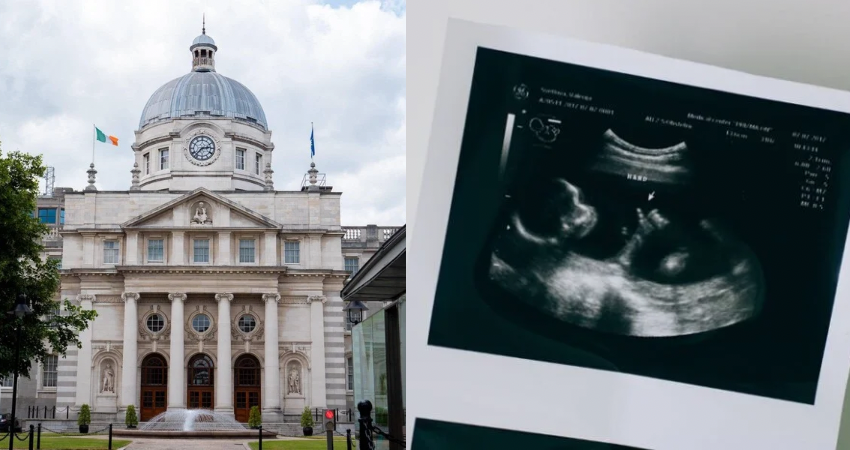
Reckless government ignoring the warning signs of a broken system, all for the sake of abortion
In June of this year, Sinn Féin proposed a bill before the Dáil seeking to scrap the 3-day wait before an abortion. It passed second stage by 86 votes to 70 — being supported by both the Taoiseach, Micheál Martin, and the Tánaiste, Simon Harris.
TDs hit out at Sinn Féin’s proposal to scrap the mandatory waiting period, accusing the party of ignoring evidence that this 3-day wait reduces the number of abortions, and argued that the abortion rate is currently so high that “it is affecting the birth rate”.
Aontú leader, Peadar Tóibín, said that Sinn Féin were amongst the political parties offering abortion instead of tackling the reasons for the collapse in the Irish birth rate.
“Last year there were 10,852 abortions in Ireland. The lives of 10,852 living human beings were ended as a result of the legislation that was passed a number of years ago. It is the highest figure on record. It is equivalent to 400 classrooms of children who are no longer with us as a result of that abortion law … So high is the abortion rate today that it is affecting the birth rate.”
On Sinn Féin’s proposal, Independent TD Carol Nolan said:
“You cannot speak about building a shared future while simultaneously dismantling the last remaining safeguard that has already saved up to 10,000 lives and Sinn Féin knows this. The data is not mine; it is the HSE’s own data provided to me through parliamentary questions. That data shows that thousands of women do not return after the three-day period. That is proof – proof that the waiting period gives women time, space and the chance to reconsider under pressure, coercion or crisis”.
Coerced abortion case before the courts, governments failure to act
In February this year, Letterkenny Circuit Court heard how a man in his twenties forced a woman, also in her twenties, to take abortions pills at a location in Co Donegal on Saint Valentine’s Day in 2020.
Senator Sarah O’Reilly of Aontú called for an independent review of telemedicine abortion in light of the case. Indeed, in February of this year, Aontú leader Peadar Tóibín asked Minister for Health Jennifer Carroll-MacNeill for just that: to “immediately reassess the safety and clinical appropriateness of telemedicine abortion services”.
Her response was disappointing but not surprising, starting out by placing the importance of access to “termination of pregnancy services” as central, and then shifting the blame by asserting that the telemedicine procedure is safe and “endorsed” by a litany of public bodies, such as “Royal College of Obstetricians and Gynaecologists (RCOG), the British Pregnancy Advisory Service (BPAS), the National Unplanned Pregnancy Advisory Service and the World Health Organisation (WHO)”.
Amidst the waffle, the answer was clear: no reassessment will be taking place. Like a gaslighting narcissist, the government refuses to recognise the blood on their hands or change their behaviour. It’s never their fault - the negative outcomes of the services in their domain has nothing to do with them.
HSE-funded post-abortion counselling
More than 900 women accessed HSE-funded post-abortion counselling services between 2023 and 2025, as per the data released by the Department of Health in response to a parliamentary question submitted by Aontú leader and Meath West TD Peadar Tóibín in March of this year.
According to the figures, €1,601,012 was allocated to crisis pregnancy and post-abortion counselling services in 2023. That increased to €1,681,394 in 2024 and €1,740,611 in 2025, amounting to over €5 million in total over the 3 years.
The Department also published figures showing the number of women who accessed post-abortion counselling.
A total of 265 new clients attended HSE-funded services for post-abortion counselling in 2023. That rose to 314 in 2024 before falling to 264 in 2025.
Separate figures for the MyOptions service show that 33 clients received post-abortion counselling through the service in 2023, compared with 23 in 2024 and 20 in 2025.
Taken together, the figures indicate that 919 women accessed HSE-funded post-abortion counselling across the two service categories during the three-year period.
Abortion is often justified as an entirely normal procedure that simply falls into the bracket of everyday “healthcare”. Then why are women seeking therapy afterwards?
Unwanted abortions
There is another less talked about and often ignored aspect of abortion provision — the phenomenon of unwanted abortions.
As pointed out by Roscommon for Life in their recent demonstration on August 18th, citing research from American-based Lozier Institute: unwanted abortions (that is, abortions carried out on women who described them as being inconsistent with or counter to their own values and preferences) account for 70% of all abortions in a study of 1,925 women aged 41 to 45. That is by far the majority of women sampled.
Research such as the Turnaway Study reporting that “relief” was the dominant emotion for 95% of women following an abortion can be incredibly misleading, due to the fact that this only represents women who wanted the abortion. It ignores the reality of women who undergo unwanted abortions, who feel immense emotional pain over that decision, with these negative emotions continuing at their most heightened state for up to 20 years after the fact.
What is the Irish government’s response? More abortions, less safeguards
With all this said, the Irish government seems to believe that the next step for the country is to send the already soaring abortion rate up even higher by doing away completely with one of the last remaining safeguards against abortion for unborn babies and vulnerable women: the three-day wait.
Never mind the fact that we have accounts of women who benefited immensely from the three-day waiting period and suffered greatly as a result of its absence. Both of whom represent entire cohorts of women they never even bothered to seek out and hear from, despite conducting a farcical ‘abortion review’ of the provision of abortion services in Ireland.
No, the government's ultimate plan in the face of sky-high abortion figures, women experiencing abortion-regret and undergoing post-abortion counselling, collapsing birth rates, babies being born alive during abortions, and now the very real possibility of increasing numbers of women undergoing unwanted abortions due to an abject failure on the government's account to provide real support: make it even easier to have your unborn child killed in the womb.
That’ll surely be beneficial for everyone involved.
Related News
- Life Institute submission to Health Committee: scrapping three-day wait “a significant betrayal of voter trust”
- Irish Government backs statutory abortion leave
- Over 900 women sought HSE counselling after abortion since 2023
- WATCH: TD accuses SF of ignoring proof that 3-day wait saves lives
- HSE still has no guidelines for when babies survive abortions
- SHOCKING: 575 abortions carried out with no upper gestational age limit
Featured
- Belfast City Hall “shouldn’t be used as a billboard for abortion”
- Life Institute submission to Health Committee: scrapping three-day wait “a significant betrayal of voter trust”
- Reckless government ignoring the warning signs of a broken system, all for the sake of abortion
- Rally for Life Vox Pops
- UPDATE: Life-saving surgery performed on baby at center of viral surrogacy case
- Baby born to woman who refused abortion in viral surrogacy case
- "A prince stands in the way": Liechtenstein royal blocks abortion
- Have you heard Michael Jackson’s pro-life song, ‘Abortion Papers’?
- You are not entitled to a child.
- EXCLUSIVE — Esme’s open-letter: “The 3-day wait was my saving grace. Abolishing it would be catastrophic”
- Five days to recover but not three days to consider? The contradiction of paid leave for abortion
- Let down by her GP, rushed into an abortion with no three-day wait: the future our government wants?
- Irish Government backs statutory abortion leave
- The erosion of every right for the unborn child is happening
- BMA seeks legal protection for doctors refusing assisted dying
- Over 900 women sought HSE counselling after abortion since 2023
- Rally for Life 2026
- We Remember them 2026

You can make a difference.
DONATE TODAY