
New research shows a mother’s brain adapts uniquely with each pregnancy
A recent study has found that a mother’s brain uniquely changes during her second pregnancy in relation to her first, with these changes mirroring the novel environment and interactions the mother will experience as part of her new life after welcoming her second child.
Researchers at Amsterdam UMC recently published findings in Nature Communications which show that a mother’s brain physically changes during her first and second pregnancies, in similar but also differing ways, reflecting the real lived experience of what it’s like to have another baby.
Pregnancy and the ‘Default Mode Network’
Previously, the same researchers were the first to document the neuroplastic changes to a woman’s brain after having their first baby, particularly in an area within the grey matter of the cerebral cortex known as the ‘Default Mode Network’ (DMN). This area is responsible for many functions, including self-reflection, daydreaming, social cognition and empathy. The DMN undergoes a reduction in grey matter volume, known as ‘cortical thinning’, which is a process whereby the brain fine-tunes an area in order to increase the efficiency of the cognitive tasks respective to that area. This ‘pruning’ of the DMN in relation to areas such as empathy and self-reflection is therefore understood as redirecting the brain towards aiding maternal bonding and care, adapting the mother’s brain for attending to an infant child.
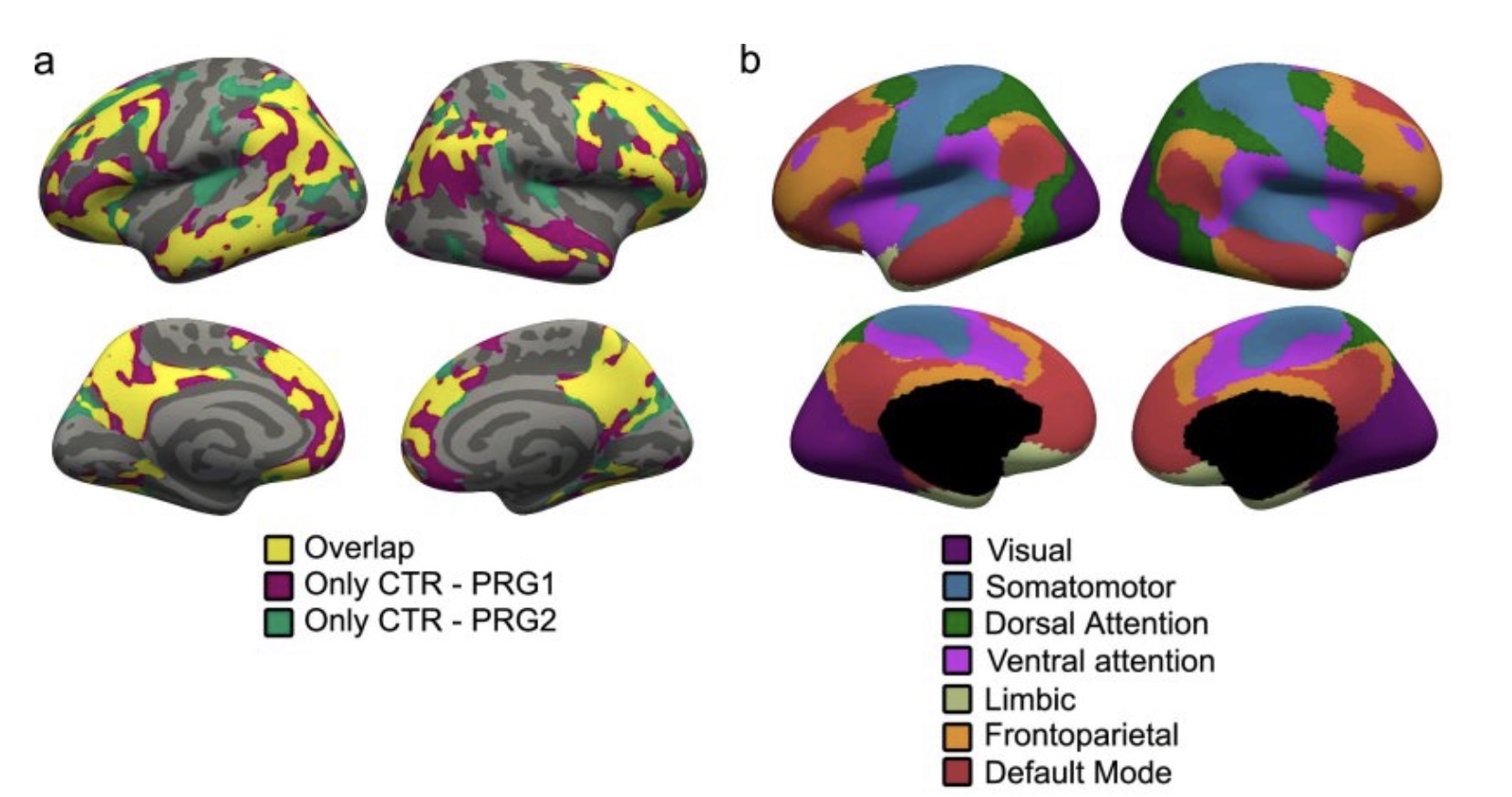
Overlapping and differing affected areas in the brain across a first (PRG1) and second pregnancy (PRG2).
Straathof M, Halmans S, Pouwels PJW, Crone EA, Hoekzema E; Nature Communications 2026 (CC BY 4.0)
The follow-up study on second-time mothers
This year, the researchers expanded on these findings by conducting another study, observing the brains of 110 women. Some were having their first baby, others their second, and the third group remained childless, acting as the control. The results were intriguing, with the researchers stating: “We have shown for the first time that the brain not only adapts during the first pregnancy, but also during the second”.
It was found that the Default Mode Network changed again in women having their second baby, but in a different and less dramatic way. Similarly, changes in the brain associated with maternal bonding were less distinct the second time around. This upholds the theory that neuroplastic changes to a mothers brain are usually most significant and widespread during her first pregnancy, where a ‘foundation’ is laid, and are less broad but more specific in subsequent pregnancies. The main changes for the women pregnant with their second, however, occurred in regions associated with goal-orientated attention and response to external stimuli. The thinning of the grey matter in these areas may be especially conducive to taking care of multiple children.
Maternal mental health
Additional findings of the study pertain to the area of maternal mental health.
The research provided evidence for connections between structural brain changes and peripartum depression (depression which affects some women during pregnancy and up to a year after the birth of their child). These changes, however, differed between first and second pregnancies. For first time mothers, these changes were most prominent after child birth, whereas for second time mothers, this was more so the case during pregnancy.
The results of these studies provide the first evidence that maternal depression relates to physical changes in the mother’s cerebral cortex. Milou Straathof, one of the scientists behind the study, commented that “this knowledge can help to better understand and recognize mental health problems in mothers. It is important that we understand how the brain adapts to motherhood.”
Comment: Women have been conceiving and bringing children into the world for the entirety of human existence, yet we are only now beginning to understand the impact of childbearing on the female brain, and therefore the mother herself. As well as showcasing the intriguing neuroplasticity of the mother’s brain, these findings will help contribute to a growing body of research into how to address and combat depression in both new and expecting mothers.
What is perhaps most amazing of all is just how made for motherhood a pregnant woman is. Once a woman conceives and begins growing a precious life inside her womb, her brain literally begins to preemptively adapt and change in order to accommodate her new life as a mother. How amazing is that? First-time mothers and even women having their second child are so often worried about how well they will cope with motherhood and the challenges that come with caring for a new baby. Research like this helps to show that oftentimes we needn’t worry - our brain is already on the case.
Featured
- Person from Victoria dies by suicide after taking assisted suicide drugs meant for their partner
- Pastor to appeal conviction for preaching John 3:16 in abortion buffer zone
- Pro-Life Victory in Belfast: City Hall Illuminated for Life
- “Deplorable”: Anger as Mansion House lit up for abortion
- Controversial abortion light-up at Belfast City Hall on hold
- Family claims 83-year-old was euthanised without giving consent
- Pro-life billboards VANDALISED in Co. Offaly
- TCD abortion “training day’ to include vacuum abortion procedure
- Cavan Choose Life: “eliminating 3-day wait is morally reckless”
- Teen hairdresser wins £30k after boss “tells her to abort baby”
- Thousands expected to gather in London for annual March for Life UK
- Belfast councillors vote to light up City Hall in support of abortion
- GP group admits it did not survey members on three-day wait
- Poll: 55% support keeping the 3-day wait before abortion
- Westminster: MPs vote against Assisted Suicide Bill
- Abortion clinics treated with more respect and protection than Mass in the UK
- Reckless government ignoring the warning signs of a broken system, all for the sake of abortion
- Belfast City Hall “shouldn’t be used as a billboard for abortion”
- Life Institute submission to Health Committee: scrapping three-day wait “a significant betrayal of voter trust”
- Rally for Life Vox Pops
- Have you heard Michael Jackson’s pro-life song, ‘Abortion Papers’?
- You are not entitled to a child.
- EXCLUSIVE — Esme’s open-letter: “The 3-day wait was my saving grace. Abolishing it would be catastrophic”
- Let down by her GP, rushed into an abortion with no three-day wait: the future our government wants?
- Over 900 women sought HSE counselling after abortion since 2023
- Rally for Life 2026
- We Remember them 2026

You can make a difference.
DONATE TODAY